Corporations vs LLCs
- Corporations and LLCs
are Both "Entities" - Entity = person
- Types of Entities
- Limited Liability Company (LLC)
- For Profit Corporation
- Nonprofit Corporation
- LLC
- Articles of Organization (filed with the State)
- Operating Agreement
- For Profit Corporation
- Pre Incorporation Agreement (optional)
- Articles of Incorporation
- Bylaws
- Stock Certificate
- Stock Ledger Book
- Stockholder Agreement (optional)
- Nonprofit Corporation
- Articles of Incorporation
- Bylaws
Why Choose an
LLC Over a Corporation
- Summary:
- Both offer limited liability protection from creditors.
- What is an LLC?
- LLCs are partnerships that enjoy limited liability similar to a corporation, except:
- In an LLC the "partners" are called "members" (unlike a true partnership an LLC can have a single member).
- In an LLC the "partnership agreement" is called an "operating agreement".
- LLCs Are Simpler to Maintain than Corporations:
- Unlike corporations, LLCs do NOT require ANY of the following:
- board of directors
- bylaws
- minute book
- LLC's are governed by an operating agreement entered into between the members. It covers the following issues:
- Capital contributions (if any) by the members
- How profits are to be split
- percentages of ownership
- management
- death, expulsion or divorce of a member
- Tax Flexibility
- LLCs can elect to be taxed as a corportation ("C corp" or an "S corp"). IMPORTANT: Owners of an LLC should consult a tax advisor. Here are the default IRS tax treatments:
- Single Member LLC: By default, the IRS treats a single member LLC as a "disregarded entity"
- Multi-Member LLC; By default the IRS treats multi-member LLCs as partnerships.
- Management Flexibility
- The LLC's Operating Agreement can authorized all of the members to share management responsibility or it can appoint one of the members to be the "manager"
LLC Limited Liability
(from creditors of the company)
- LLC members enjoy the the SAME limited liability protection as is enjoyed by stockholders of a corporation.
- LLC's often offer better protection than a corporation because there are far fewer "formalities" to comply with (no need for boards of directors, minute books, bylaws, etc).

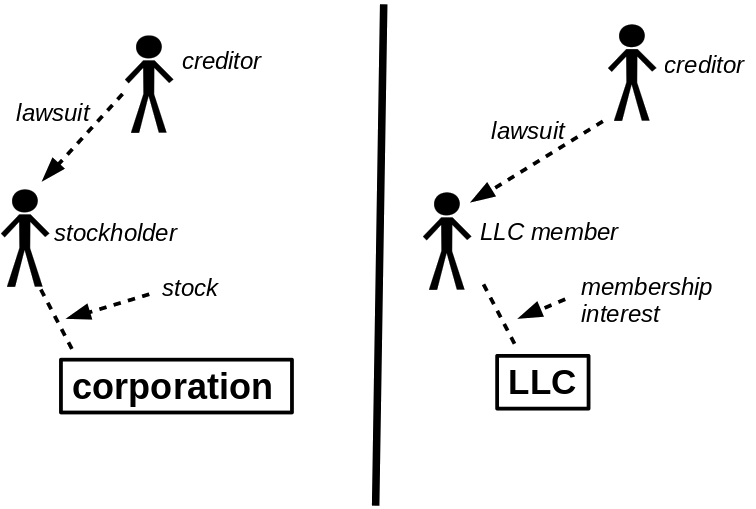
Better Protection from
Creditors of an Owner
- Creditors can sue a stockholder in a corporation and get a money judgment and then have court seize the stock
- This is NOT true with for LLCs (membership interests can NOT be seized by a court).
- BUT in Florida, creditors can have the courts seize the membership interest if the LLC has only one member
- Single member LLCs should consider incorporating in a state like Delaware or Wyoming where single-member and multi-member LLCs are treated the same.
Is There Any Reason to Form a Corporation?
- Typically the ONLY reason someone would want to form a corporation would be to have the ability to issue stock certificates to accommodate investors.
Making an S-Corp Election
can reduce "Self Employment Tax
- If the LLC has NOT elected to be taxed as an S-Corp the members are considered to be self-employed and, as such, are subject to "self-employment tax" based on the ENTIRE net income of the LLC
- If the LLC has made an S-Corp election all members active in providing services are considered to be employees and the self-employment tax is based only upon the salary paid to the member and not the entire net profit of the company.
Staying Out of Trouble with an LLC
- The business of the LLC must be kept distinct from the business of the members.
- It is important that an LLC have its bank account and credit cards in the name of the LLC.
- A separate bank account makes it easier to track company's income and expenses, thus, making it easier to compute and pay taxes for the business.
- The members of an LLC should never pay the LLC's debts with their own personal credit cards or checking accounts.
- If the LLC needs money to pay a bill, the member can make a "capital contribution" to the LLC by depositing money into the LLC's account so as to allow the LLC to then make the payment.
- Always have an LLC Operating Agreement
- This documents identifies LLC's owners are and states who has authority to act on the LLC's behalf
- For a single member LLCs the Operating Agreement can designate a successor owner in the event that the current LLC owner dies