
Prospectus
Green Infrastructure Water and Sewers Since much of the project
area still uses septic systems and has inadequate stormwater
infrastructure, there is an opportunity for innovative "green" sewers
and stormwater systems that can become a model for the region. These
new technologies, linked to good urban design, can A number of new
technologies are relevant to the 79th Street target area, some of which
have already been proposed for the adjacent Hialeah. They include: *-- Redesigning streets and street median strips to
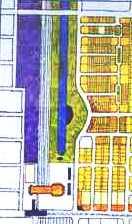
serve as stormwater retention areas, *-- Utilizing undeveloped land for engineered
wetlands and holding ponds for stormwater retention, and *-- Biological treatment of sewage in greenhouses. These technologies would
simultaneously green the community with trees and vegetation and create
open space and recreation areas. Action 7:
Inventory the Water and Sewer Infrastructure System in the Target Area. The project will develop a
detailed map of the community's water and sewer infrastructure and use
that inventory to evaluate and scale the needs for new infrastructure. Action 8:
Inventory Alternative Design and Technology Options for Green
Stormwater and Sewer Infrastructure. This research effort will
identify all of the green options for stormwater and sewer
infrastructure relevant for the community so that the community would
have the greatest possible range of options. Action 9: Evaluate
Financing Options for New Infrastructure. Using the options described
in Section V below, the project will develop alternative financing
scenarios for these technological options.DensityAction 10: Develop an
Infrastructure Strategy. The results of Actions 10,
11 and 12 will inform the development of a 79th Street Corridor
Infrastructure Strategy that will be incorporated in the overall
Sustainable Development Plan. B.
Transportation While the target area's
transportation access to Miami-Dade County and the three-county area is
good, the challenge is intra-community mobility. Some residents,
particularly seniors and youth, cannot drive, so such a
community-centered transportation strategy is essential. For others,
efficient intra-community mobility could make the difference in being
able to live a full life without owning a car. There are at least three
elements of a community mobility strategy: *-- Sidewalks: Good quality sidewalks throughout the community, *-- Strong pedestrian linkages: A community design which
encourages and enhances pedestrian access to jobs and amenities, and *-- Jitneys: An intra-community transportation system that
links with public transit, shopping, etc. Action 11: Develop
an Intra-Community Mobility Strategy. Inventory existing
intra-community transportation assets and identify barriers to
mobility; then explore and evaluate a range of options to enhance
intra-community mobility. C
Energy Decreasing energy demand
and increasing energy reliability should be two goals of the 79th
Street Corridor Sustainable Development Strategy. This can be
accomplished through a number of initiatives including: *-- Micro-Grid Analysis: Evaluation of the electricity distribution system
in the target area to identify potential peak loading problems and
demand reduction opportunities to decrease peak loads, improve system
reliability, and strengthen the neighborhood economy. *-- Solar Energy: Evaluation of the potential for solar energy in
the community, including the retrofit of existing structures and the
incorporation of state-of-the-art solar technology into new housing and
commercial development. Action 12: Develop
an Energy Conservation and Reliability Strategy. The project will model
energy use in the target area and explore a range of approaches to
decrease energy use, decrease energy costs, and increase energy
reliability. D.
Telecommunications More and more economic
transactions are handled electronically, requiring access to high speed
fiber optic transmission lines. Communities that can tap in this
transmission network will experience a much wider range of jobs and
economic development options than those that do not. The 79th Street Corridor
should be able to take advantage of the railroad and transit
rights-of-way to gain fiber optic access. With this technology serving
the neighborhood, a reservation center serving the port, for example,
could be located at the Amtrak site, which is adjacent to these
rights-of-way. Action 13:
Evaluate Access to Fiber Optic Telecommunications Transmission Lines
and Development Opportunities that are Fiber Optic-dependent. The project needs to assess
the state of fiber optic technology in South Florida and its
relationship to the 79th Street target area. It also needs to evaluate
the extent to which telecommunications-related industry is locating in
South Florida and what it would take to make it a component of the 79th
Street development strategy |
 reshape
the face of the community.
reshape
the face of the community.