
Back to Archive Page
7/12/02 - Miami Today News
Micro Business USA
By: Frank Norton
Judy Bustamonte wasnÆt happy working for somebody else, so he quit his job
and started brokering waste removal contracts on his own.
 Business went well
for awhile, but Bustamonte wanted more. Although he had little business experience
and no working capital, he was able eventually to borrow $25,000. He used the money
to buy two trucks and some office equipment, which he used to start his own waste
removal company, named Better Waste Management.
Business went well
for awhile, but Bustamonte wanted more. Although he had little business experience
and no working capital, he was able eventually to borrow $25,000. He used the money
to buy two trucks and some office equipment, which he used to start his own waste
removal company, named Better Waste Management.
The company grossed about half a million dollars by year-end 2001, he said.
For Bustamonte and hundreds of entrepreneurs like him, opportunity came in the form
of access to capital, something that for many inner-city and minority entrepreneurs
doesnÆt usually come easy. He tried to get conventional financing, but couldnÆt
find a bank willing to underwrite his new endeavor.
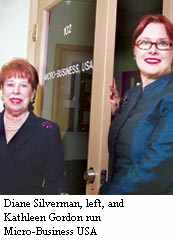
ThatÆs where Kathleen Gordon and Diane Silverman came in. They head Micro-Business
USA, a federally funded program started in 1999 that is attempting to create an
economy where there is none among South FloridaÆs creditless.
Silverman, MicroÆs executive director, can be heard regularly on radio station
Hot 105 FM. The spots pitch her company to South FloridaÆs no-credit, no-collateral
untouchables as an avenue for getting a shot at growing their own business.
As a Small Business Administration lender, Micro-Business lends small amounts of
money, in a program formally known as MicroLoan, to the very people that banks canÆt
afford to or just donÆt want to deal with. Micro-Business gets half its lending
capital from the SBA and the other half from Miami-Dade County.
Roots in Bagladesh
The micro-loan concept was born in Bangladesh in 1976, when Muhammad Yunus, a former
economics professor, started the Grameen Bank. Yunus wanted to create a system to
empower rural women. The basic idea was to plant many small seeds of capital that
could flourish into an entrepreneurial movement, lifting hundreds of women out of
the vicious cycle of poverty.
In Miami, the idea is pretty much the same, but the focus is not rural women, but
mostly on inner-city residents. The goal is to revitalize blighted urban communities,
like Overtown, Brownsville, Wynwood and Liberty City, by sparking neighborhood businesses
and then mainstreaming them into the greater local economy.
According to Silverman, the demand in Miami is overwhelming. Not surprising, since
Miami was recently ranked as the poorest large city in the United States by the
U.S. Census Bureau. An estimated 31.9 percent of the population in greater Miami
lives below the poverty line.
For prospective entrepreneurs who donÆt know anything about running a business
or how to get an idea off the ground, the terms are pretty simple, and the process
of getting a loan is whatÆs known as ôpeer lending.ö
Candidates submit a business plan to Micro-Business USA. It doesnÆt have to
be perfect, just an earnest work in progress. Candidates attend peer group business
training classes and earn the right to borrow $500 at an interest rate of 12 percent
per year. That small sum is enough to buy a salon kit, fax machine, basic kitchen
equipment or whatever it is the would-be entrepreneur needs to get started. Micro-Business
clients move to higher tiers and are allowed to borrow larger sums of money as they
pay back previous loans and attended business classes.
Latrell Vanderhorst, for example, needed a laptop computer and some accounting software
to start free-lance bookkeeping for other small businesses in Broward County, where
she lives.
$500 beginning
Vanderhorst started with a $500 loan and moved forward together with other peers
in her business training classes, each paying back the individual loans in four
months before collectively passing on to Levels 2 and 3, where seasoned entrepreneurs
can access as much as $35,000.
Vanderhorst recently borrowed an additional $2,000 for flyers and a Compaq Presario
III. In 2001, she grossed $37,900, pocketed about $10,000 and even paid out wages
to others in her community who helped out. Not bad for a part-time endeavor that
she is trying to grow into a full-time business.
ôTen percent of any population is entrepreneurial, regardless of race, color
or creed. But most people wouldnÆt know whether theyÆve got it or not
unless theyÆve had the opportunity to find out,ö Silverman said.
In 2000, Silverman helped provide 285 loans totaling $1.2 million, falling a bit
recently due to program restructuring, she said.
Nationally, micro-lending has only been around about 10 years. It has been embraced
the world over. The Washington D.C.-based Inter-American Development Bank, for example,
recently began shifting some of its focus away from large infrastructure loans to
governments toward smaller projects meant to have more of a local, rural impact.
According to the Aspen Institute, a think tank in Colorado, there are now at least
550 micro-lenders operating in 44 states, though not all are funded by the SBA.
These organizations reported assisting 9,800 borrowers with a combined portfolio
of $67 million in 2000.
Job creation
Micro-Business USAÆs loan repayment rate is 90 percent - on par with the national
average. The success rate of the start-ups they capitalize is harder to measure,
probably more than 10 percent if success is measured by the creation of a sustainable
enterprise, Silverman said.
ôThe focus is on job creation,ö Silverman said, who adds that Micro-Business
has helped create hundreds of jobs since its creation and helped empower scores
of entrepreneurs who might not have been given the opportunity otherwise.
Some micro-credit skeptics argue that the effort in the U.S. is rather moot, given
the sophistication of U.S. capital markets and relative availability of credit.
But Miami banking analyst and community redevelopment expert Ken Thomas disagrees.
South Florida bankers have traditionally not been as responsive to community redevelopment
as those in other parts of the country, he said. And local micro-borrowers share
his perception.
ôBanks do not lend money to start-ups. Nobody is interested in start-ups,ö
said Judith Carter, a recent borrower who parlayed her years of experience in managed
health are into Reliant Medical Supplies Inc., her own Lauderdale Lakes start-up
that last year grossed more than $250,000. The Jamaican-born Carter is trying to
borrow $15,000 this year to help meet her companyÆs growth needs.
Bustamonte echoed her sentiments. ôEvery lender I went to gave a me different
story, but the bottom line ù they just plain didnÆt want to lend me
the money,ö he said.
For bankers itÆs a simple business decision. ôMost commercial lenders
wonÆt touch anything below $2,500, especially for businesses that arenÆt
established yet. You just canÆt make money on loans that small,ö said
Buster Castiglia, president of Continental National Bank of Miami.
Still, Thomas said prospective low- and middle-income borrowers have a responsibility
to exhaust all other options before heading on down to Micro-Business USA.
ôWe have the most developed and well capitalized financial structure in the
world, and weÆre going to go outside the system to something developed in
the third world in order to access credit?ö he said. ôYes, the need is
there and it should be filled, but only as long as the goal is to graduate people
back into the financial system.ö
And thatÆs what Micro-Business is trying to accomplish. The required training
in the peer lending process forces borrowers to track their money and start building
a credit history, the basic building block of entrepreneurship, Silverman said.
ôItÆs behavior modification without you even knowing it, because most
people think the money is the sexy thing,ö she said. ôItÆs not
at all. ItÆs the training and the peer support that make the program. Even
people that have been in business often do not have the skills or financial literacy
to start out handling large sums of money. à Credit is like medicine. A little
bit is good, but too much can kill the patient.ö