 Return to floridacdc.org
mainpage
Return to floridacdc.org
mainpageThe "Lienfield" Initiative Recycling Lien-Infested Inner City Properties 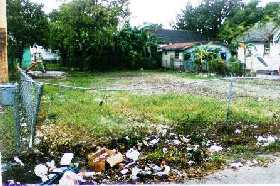 Definition
of "Lienfield": "Lienfields" are abandoned inner-city properties
that accumulate unpaid taxes year after year which developers avoid because the
cost of paying all the back taxes often exceeds the economic value of the land. Definition
of "Lienfield": "Lienfields" are abandoned inner-city properties
that accumulate unpaid taxes year after year which developers avoid because the
cost of paying all the back taxes often exceeds the economic value of the land.The Solution - a "Lienfield Initiative": We need work with the Miami-Dade Housing Agency to create a local program that will allow them to (1) acquire title to the abandoned lien infested properties, (2) waive the back taxes, and then (3) make the parcels available for redevelopment. The Opportunity: In 1999 State Senator Kendrick Meeks sponsored legislative amendments that reformed Florida's archaic procedures for dealing with tax delinquent properties. The amendments significantly shortened the time period that local government had wait to acquire title to lienfield properties. If the land was to be used for "infill housing development", local government could to acquire the parcels without having to pay the back taxes and without conveying title to a local municipality. Local governments, however, need to create mechanisms to take advantage of this opportunity. The Law Prior to Senator Meek's Amendments: AN OVERVIEW OF "TAX CERTIFICATES" In some states, like New York, local governments can directly take title to seriously tax delinquent properties and re-cycle them for redevelopment, but that's not the case in Florida. Instead, investors are solicited to pay off the back taxes owed by deadbeat property owners. Florida Statutes Chapter 197 gives to the state's taxing authorities the power to sell tax certificates in order to recoup revenue lost because of unpaid property taxes. Each year the county  holds an public auction at which
private citizens can bid on the tax certificates. Each certificate is valued at
the amount of the taxes owed for that year on an individual piece of property. The
certificate accrues value at the rate of interest set by the bidding process until
someone with a valid interest in the property redeems the certificate from the county.
At that time the certificate holder recoups his investment when the county pays
him the value of the certificate. holds an public auction at which
private citizens can bid on the tax certificates. Each certificate is valued at
the amount of the taxes owed for that year on an individual piece of property. The
certificate accrues value at the rate of interest set by the bidding process until
someone with a valid interest in the property redeems the certificate from the county.
At that time the certificate holder recoups his investment when the county pays
him the value of the certificate.The true value of the certificate to many private holders lies in the provision giving him the option, after a waiting period, of acquiring the property for the value of the taxes owed. He does so by applying for a tax deed, paying a deposit equal to the sum of all taxes owed on the property. Upon receipt of such an application the Clerk advertises and holds a public sale at which the minimum bid for the property is the tax certificate holder's deposit. The property is sold to the highest bidder. Certificates not redeemed, or for which no tax deed has been applied expire 7 years after they have been issued. Certificates on economically valuable parcels are gobbled up at the auctions. This fact allows the county to collect money to replace the unpaid taxes. Additionally, the waiting period allows the delinquent taxpayer time to pay the taxes and recover the property, if he so desires or is able to. The certificate holder makes an investment which he recoups, either by collecting the interest on the certificate, or by acquiring the property at below-market prices for the sum of the taxes owed on the property. Thus, the process described above serves several functions. A very different situation exists with respect to those properties that are not economically attractive (and thus unable to attract bidders at the tax certificates actions). The statute requires that the tax collector issue the tax certificate to the county where: a) there are no bidders at the public auction; or (b) the certificate represents delinquent taxes of less than $100.00 on homestead property. After a two year waiting period, the county must apply for a tax deed on the property, (although unlike the private certificate holders the county is not required to make a deposit). Upon receiving such an application the Clerk advertises and holds a public sale. If no one bids for the property, the county can either buy the property by paying all the back taxes or continue to keep the property available for sale by placing it on a "List of Land Available for Taxes" for an additional waiting period. Taxes continue to accrue during this second waiting period. If this period expires with no takers for the property the title, finally, escheats to the county. The county was required to then transfer title to the municipality within whose boundaries the property lies. SENATOR MEEKS' 1999 AMENDMENTS 1. Shortening the Period Time Property Must Sit on the "List of Land Available for Taxes" As stated above, after two (2) years certificate holders may apply for a tax deed at which time the Clerk holds a public sale (the County must apply for a tax deed on the certificates that it holds in most cases). The amendment shortens from seven (7) years to three (3) years the waiting period following the public sale during which unsold properties will continue to accrue taxes until they are either bought or, failing to attract a buyer, escheats to the county free and clear of all back taxes and liens 2. Changes to Allow the County to Forgive Liens on Land it Acquires for Infill Housing: Under present law the County is allowed to "purchase" certificate properties at the public sale (which occurs 2 years after the certificate's issuance) by payment of all back taxes. The amendment allows the Board of County Commissioners, for properties being acquired for the express purpose of providing "infill housing", to cancel all county-held tax certificates and omitted years' taxes on the properties in being acquired. NOW THAT THE AMENDMENTS HAVE BEEN ADOPTED: Outline of the Statutory Steps for County to Obtain Title to Tax Delinquent Properties
|