The Challenge of Making Home Repair Loans.
Home repair loans to low income owners are difficult. Home owners can't usually find good contractors. Why would a reputable contractor want to do a low profit - high risk deal (once you start a rehab project who knows what kind of unforeseen problems you will encounter - "you don't know what you'll find behind the wall", etc.). Many of the contractors who bid on these type of projects turn out to be incompetent and dishonest. Low income homeowners have difficulty properly managing contractors after they have been retained (regardless of whether they are good or bad).
The Root Cause of the Problem - Muddled Relationships
The first step in staying out of trouble is for the Lender to have a clear understanding in the back of its mind of the precise nature of the relationships between the parties. The a diagram below outlines the legal relationships between the homeowner ("Borrower"), the Contractor retained to do repairs or rehabilitation, and the Lender.
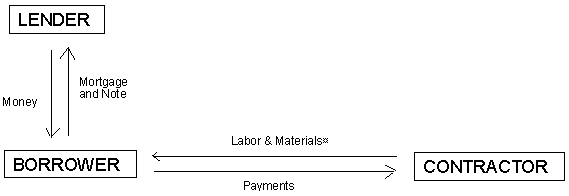
The Lender's legal relationship is with the Borrower and not the Contractor. The Contractors legal relationship is with its customer, the homeowner, and not the Lender.
A Trap for Lenders:
Borrowers typically are inexperienced in dealing with Contractors. Nonprofit Lenders, therefore, often see a need to take it upon themselves to try and help their Borrowers with tasks such as bidding, contract execution, negotiating change orders, and directly supervising the contractor.
The Risk:
Such involvement in the "business" of the Borrower, however, exposes the Lender to potential liability whenever there is a dispute between Contractor and the Borrower (which is often). "Lender Liability" is an emerging area of the law.
If the Lender is not careful the Borrower might be led to believe that the Lender was supervising the work of the Contractor and/or making disbursement decisions not fully acceptable to the Borrower. Thus when the Contractor fails to do the work properly the Borrower may point his or her finger at Lender as the alleged guilty party (essentially, a claim that the Lender was negligent in performing the supervision duties it had undertaken).
Contractors, on the other hand, sometimes might get the wrong impression that the Lender is a party to their agreement with the homeowner or the Borrower's agent. Thus when the Borrower refused to authorize a draw request on account of shoddy work, the Contractor might start making demands upon the Lender.
The Lender's Goal: To immunize the itself (as much as possible) from these types of claims.
Recommendations: "Tighter" Contracts and Lender Inner Discipline
- A detailed description of the specific work to be done by the Contractor would be described in an attachment labeled "Scope of Work"
- The before approving a particular contract the Lender would assure itself that the "Scope of Work" section accurately and precisely described the work that was to be done (thus minimizing the potential for subsequent disputes). The Lender would reject proposed contracts with inadequate descriptions of the Scope of Work.
- The "boilerplate" language of the suggested contract form would, in plain and descriptive English, describe in detail the Lender's disbursement requirements, including a description of the types of information that must be included in each of the Contractor's invoices to the Borrower.
- The contract would require that the Contractor submit all of its invoices directly to the Borrower (its customer) and not to the Lender.
- The contract would specify that the Lender will disburse only upon the following conditions.
- That a payment request (on a form proscribed by the Lender) had been signed and submitted by the Borrower with the Contractor's invoice attached.
- That the payment would be made only if the Lender, after inspection was reasonably satisfied that the work had been properly done.
- This type of procedure will prevent the Borrower from later complaining that the Lender paid for work that was not satisfactory to the Borrower. It will also minimize the chances that the Contractor will start sending demand letters to the Lender every time a disbursement request is rejected.