Building Affordable Homes in the Historic "Village West" Community of Miami's Coconut Grove
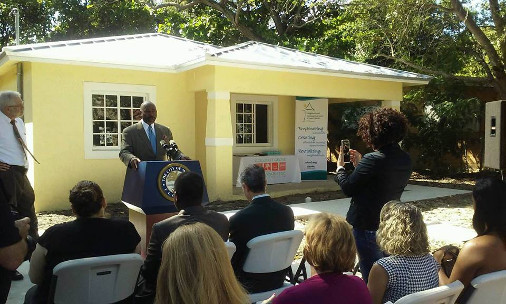
Village West Homes LLC is a partnership between Collaborative Development Corporation and Neighborhood Housing Services of South Florida Inc. both of which are Florida not for profit corporations. The business of the partnership is to acquire building lots in the Village West community and then to use financing from the City of Miami and other sources to construct and sell affordable houses to qualified low and moderate income families.
|
Statement from Commissioner
Marc D. Sarnoff, District 2 - City of Miami
Whenever given a choice, it is always more prudent to own a home verses renting an apartment. Homeownership
 builds personal wealth, establishes roots in the community and is a source of personal pride. In order to assist
the residents of Village West gain access to these opportunities in their own neighborhood, the District 2 office has made a specific dedication of federal funds towards increasing the number of homeowners in this historic community. I look forward to welcoming the new homeowners at the ribbon cutting ceremony for these new homes under construction in Village West.
builds personal wealth, establishes roots in the community and is a source of personal pride. In order to assist
the residents of Village West gain access to these opportunities in their own neighborhood, the District 2 office has made a specific dedication of federal funds towards increasing the number of homeowners in this historic community. I look forward to welcoming the new homeowners at the ribbon cutting ceremony for these new homes under construction in Village West.
|
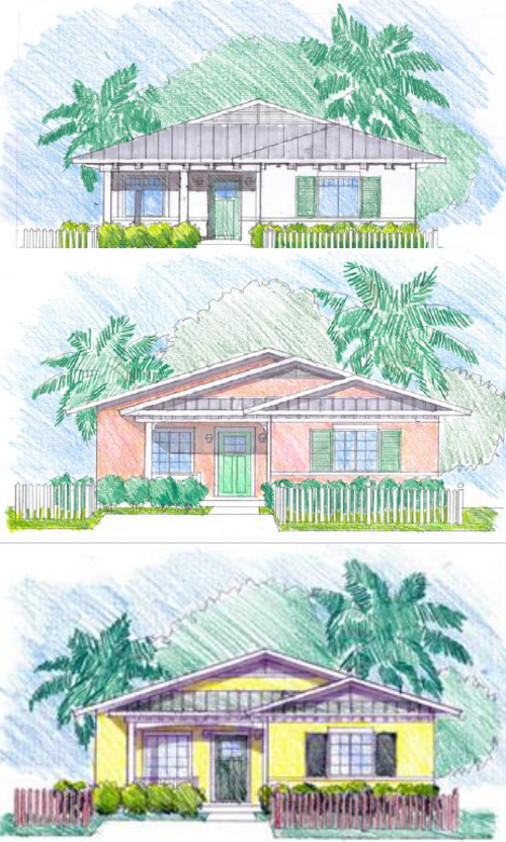
Illustrative Home Elevations
|
|
Links to Partner Websites
|
|
Request For Proposals (RFP)
|
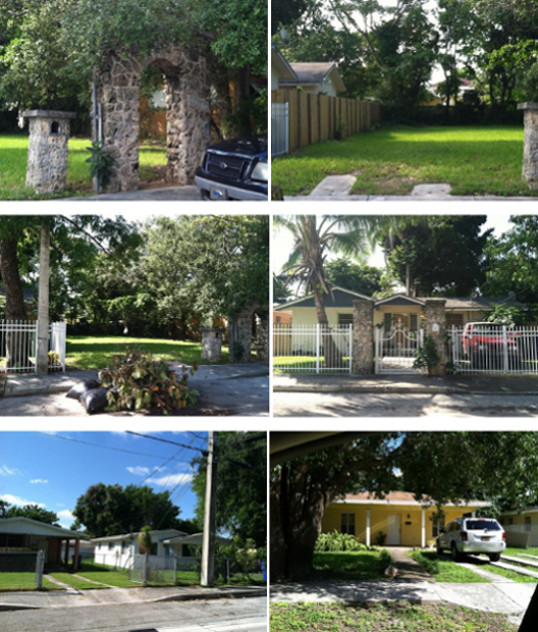
Village West Homes LLC is seeking qualified contractors to construct homes on parcels of land that it owns
|
|
Coconut Grove's
Historic Village West
|
Coconut Grove is the oldest community in Miami Florida. It has a total population of about 30,000 residents. It pre-dates the
 incorporation of the City of Miami. Situated on Biscayne Bay, this 4.17 square mile community includes the Village West neighborhood which is the present day historic enclave of the Bahamian and African-American descendants of the early settlers of Coconut Grove.
Their presence as the first black community on the South Florida mainland began here in the late 1870s when Blacks primarily from the Bahamas came via Key West to work at the Peacock Inn. Their first-hand experience with tropical plants, agriculture and building materials proved invaluable to the development of Coconut Grove.
Among the valuable contributions made by this thriving community to South Florida was in architecture and their know-how to construct simple sturdy houses able to withstand the most intense hurricanes. These houses, many of which still stand today, are extremely durable having been made of Dade County pine, a termite resistant and affordable building material (although it is now a relic of the past). Other local materials such as coral-rock were used as well, giving these structures a very distinct look. The style of house that was most used by these settlers is often referred to as a "shotgun house". which can be traced back to West Africa. It is an architectural style that enslaved Africans, particularly the Yoruba, brought with them to the countries of the Caribbean and to the United States. The name "shotgun" was given because of the typical alignment of the house's doors; supposedly, a bullet fired at the front door would pass straight through the house and out the back door. The rooms are lined up, one behind another, usually the living room, then one or two bedrooms, and the kitchen at the back. The shotgun houses are usually tiny (12ft wide) constructed on piers with no set back from the street, a front porch, wood frame, wood siding and sometimes, chimneys made of stone.
Besides private homes, the early buildings included the Odd Fellows Hall, which served as a community center and library, Macedonia Missionary Baptist Church, home of the oldest black congregation in the area, and the A.M.E. Methodist Church, which housed the community's first school. At the western end of Charles Avenue is one of the area's oldest cemeteries where legend has it that Michael Jackson filmed graveyard scenes for his famed "Thriller" music video.
Coconut Grove's Village West enclave is known regionally, nationally and internationally because of its culture, arts history and festivals such as Goombay. This event encompasses various social activities and traditional Bahamian folklore attracting thousands of people every year.
|
|
